Abstract
On 23 March 2014, the World Health Organization issued its first communiqué on a new outbreak of Ebola virus disease (EVD), which began in December 2013 in Guinée Forestière (Forested Guinea), the eastern sector of the Republic of Guinea. Located on the Atlantic coast of West Africa, Guinea is the first country in this geographical region in which an outbreak of EVD has occurred, leaving aside the single case reported in Ivory Coast in 1994. Cases have now also been confirmed across Guinea as well as in the neighbouring Republic of Liberia. The appearance of cases in the Guinean capital, Conakry, and the transit of another case through the Liberian capital, Monrovia, presents the first large urban setting for EVD transmission. By 20 April 2014, 242 suspected cases had resulted in a total of 147 deaths in Guinea and Liberia. The causative agent has now been identified as an outlier strain of Zaire Ebola virus. The full geographical extent and degree of severity of the outbreak, its zoonotic origins and its possible spread to other continents are sure to be subjects of intensive discussion over the next months.
Introduction
On 23 March 2014, the World Health Organization (WHO) issued its first communiqué (WHO, 2014a) on a new outbreak of Ebola virus disease (EVD), which began in December 2013 in the Republic of Guinea, initially in the Prefecture (province) of Guéckédou in Guinea’s eastern rainforest region, Guinée Forestière (Forested Guinea), then spreading to the Prefecture of Macenta, 80 km to the east. Located on the Atlantic coast of West Africa, Guinea is the first country in this geographical region to report an EVD outbreak with more than one case (Fig. 1a). Cases have now also been reported at several other locations in Guinea, as well as in neighbouring Liberia (Fig. 1b). The appearance of cases in the Guinean capital, Conakry, represents the first large urban setting for EVD transmission. Another case passed through the Liberian capital, Monrovia, but with no reports of any further transmission within the city. Suspected cases in the neighbouring republics of Mali and Sierra Leone have so far tested negative at the time of writing (Fig. 1b, 25 April 2014).
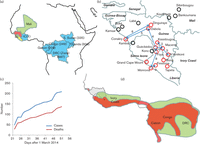
(a) Guinea (red) and Liberia (yellow) where cases in the current EVD outbreak have been confirmed. Countries with candidate cases that have tested negative are shown in green, and countries with previous EVD outbreaks in blue, with the total numbers of cases in previous outbreaks from 1976 to 2012 shown in parentheses. DRC, Democratic Republic of Congo; IC, Ivory Coast; SL, Sierra Leone. (b) Spread of EBOV within Guinea and neighbouring countries. Red circles indicate WHO-confirmed outbreak areas and black circles indicate areas where candidate cases have proved negative. 1, Initial cases in Guéckédou (from December 2013) transmitted to Macenta (February 2014); 2, transmission to Macenta to Kissidougou (late February 2014); 3, transmission from Macenta to N’zérékoré (February/March 2014); 4, transmission to Dabola (unknown); 5, transmission to Conakry (before 17 March 2014); 6, funeral of Conakry victim returns to Watagala (Dinguiraye Prefecture); 7, transmission from Guéckédou to Liberia (March 2014); 8, Liberian case travels from Foya (Lofa county) to Monrovia (Montserrado County, 29 March 2014); 9, case travels on to Firestone (Margibi County; dies 2 April 2014). (c) WHO cumulative incidence of candidate cases of EBOV (in Guinea only; Liberia not included) through late March and early April 2014. (d) Fruit bat ranges: little-collared fruit bat (green) and hammer-headed fruit bat (red). The asterisk indicates Guéckédou (outbreak initial location).
Clinical profile
EVD is a severe haemorrhagic fever caused by negative-sense ssRNA viruses classified by the International Committee on Taxonomy of Viruses as belonging to the genus Ebolavirus in the family Filoviridae (order Mononegavirales). Filovirus particles are 80 nm in diameter and form twisted filaments (hence the name) of up to 1.1 µm in length. One other genus in this family, Marburgvirus, contains viruses causing a similar disease to EVD. The third genus, Cuevavirus, is confined to bat hosts. The case fatality rate in EVD is so high, approaching 90 % in some outbreaks (Table 1), that members of the family Filoviridae have been classified as Category A potential bioterrorism agents by the Centers for Disease Control and Prevention (CDC, 2014). All bodily fluids are infectious, requiring the use of full-body protective clothing by medical and surveillance staff. Epidemiological control is also made especially difficult due to the highly variable incubation period of 1–25 days (Dowell et al., 1999), and the long Ebola virus-positive period of some recovered patients (Rodriguez et al., 1999; Rowe et al., 1999). These figures are necessarily approximate because of the low number of confirmed survivors in which testing has been carried out. Patients initially present with fever, headache, joint/muscle and abdominal pain accompanied by diarrhoea and vomiting (Paessler & Walker, 2013). In its early stages, EVD is easily confused with other tropical fevers, such as malaria or dengue, until the appearance of the haemorrhagic terminal phase, presenting with the characteristic internal and subcutaneous bleeding, vomiting of blood and reddening of the eyes. If sufficient blood is lost, this leads to renal failure, breathing difficulties, low body temperature, shock and death (Paessler & Walker, 2013). ‘Cytokine storm’ with immune suppression of CD4 and CD8 lymphocytes is a candidate mechanism for production of the terminal haemorrhagic fever (Wauquier et al., 2010). Current treatment of EVD is purely symptomatic. However, the antiviral drug favipiravir has produced some promising results in laboratory-infected mice (Oestereich et al., 2014), and vaccine development is under way (Marzi & Feldmann, 2014).
The last outbreak of EVD was in the Democratic Republic of Congo (DRC) in 2012, caused by the species Bundibugyo ebolavirus. However, the cause of the present Guinea outbreak has been confirmed by full-genome sequencing (Baize et al., 2014) as an outlier strain of Zaire ebolavirus, the species from which the genus takes its name. Zaire EBOV (EBOV) was first detected in 1976 (Pattyn et al., 1977) and has a 19.0 kb non-segmented genome encoding eight proteins. EBOV’s last clinical appearance in human populations was in the DRC in 2007 and 2008 (Grard et al., 2011). Over those 2 years, there were 296 suspected cases in total, of which 201 died. Table 1 gives the suspected case numbers and fatality rates for all EBOV outbreaks since 1976. The total case fatality rate for EBOV from 1976 to 2008 is 79 %.
West African outbreak narrative
From the start of the outbreak, now identified as December 2013 (Baize et al., 2014), to 20 April 2014, 242 suspected cases in Guinea and Liberia had resulted in a total of 147 deaths (WHO, 2014b). With a 61 % fatality rate so far, the West African EBOV outbreak is therefore the least severe since that in Gabon in 1994, which had a 60 % fatality rate (Table 1). Table 2 gives the case and fatality rates in the geographical localities as of 20 April in Guinea (WHO, 2014b) and Table 3 gives the corresponding numbers as of 9 April in Liberia (WHO, 2014c). The locations are mapped in Fig. 1(b). Fig. 1(c) records the progress of the disease using WHO suspected cases. As of 20 April, 112 cases from Guinea have had genome sequences at least partially obtained, all of which are EBOV, and 69 deaths have been confirmed as EBOV positive, giving a confirmed case fatality rate of 62 % (WHO, 2014b).
The initial source of the outbreak appears to be the village of Meliandou in Guéckédou Prefecture, and the index case a 2-year-old child who died on 6 December 2013. From Meliandou, EVD spread to five other locations in Guéckédou by the beginning of March 2014 (Baize et al., 2014). Guéckédou remains the main location of the outbreak with 122 suspected cases as of 20 April 2014 (WHO, 2014b). EVD appears to have been transmitted to Macenta by early February 2014 and then to Kissidougou by late February 2014 (Baize et al., 2014).
The first death in the capital city of Conakry (population >2 million) was a businessman who had travelled from Dabola in central Guinea. He became ill on 17 March 2014 and died the following day. He is suspected to have contracted EVD in Dabola through contact with a visitor from Guéckédou who also subsequently died from suspected EVD. The dead businessman’s body was taken from Conakry to Watagala, his village of origin (near Dinguiraye, north of Dabola). His four siblings who lived in Conakry, and who travelled with the body, and four other mourners at his funeral have all tested positive for EBOV (Guinéenews, 2014). Since then, the total number of suspected cases presenting in the capital has risen to 53 (WHO, 2014b). Several suspected cases in the west of Guinea, at Kamsar, Boké and Labé, have all tested negative (Bah, 2014a). The indirect impact of the outbreak on the Guinean economy has been extensive, with the transport, tourism and entertainment sectors badly affected as people avoid crowded situations. Fewer miners have reported for work, which may eventually have global implications, given that Guinea has one-half of the world’s supply of bauxite, as well as significant iron, diamond and gold deposits (Bah, 2014b).
The neighbouring republics of Sierra Leone, Mali and Liberia have also reported suspected cases. Those from Sierra Leone have tested positive for Lassa fever, and EVD is not currently believed to have entered that country (WHO, 2014d). Likewise, the suspected cases in Mali have all tested negative for EBOV (WHO, 2014e). In Liberia, EVD appeared in the northern town of Foya, close to the Guinean border and only 24 km from the outbreak’s main focus in Guéckédou. A woman arriving from Guinea transmitted the disease to her sister in Foya, who then travelled to the Liberian capital Monrovia (population approx. 1 million), and then on to visit her husband in Firestone Rubber Plantation Camp, north-east of the city, before dying on 2 April 2014 (FrontPageAfrica, 2014; Nah & Johnson, 2014). Three other foci in Liberia have not yet been connected to Guinea or the other Liberian cases.
Evolution and ecology of Ebola virus
Table 4 shows the degree of sequence divergence between a selection of Ebolavirus species, including new strain Guéckédou-C05 (Baize et al., 2014), after alignment of whole genomes in mega (Tamura et al., 2013). The greatest genetic divergence is between Tai Forest ebolavirus (strain Côte d’Ivoire) and Reston ebolavirus (strain 08-C) with 36.3 % of base positions differing. The mean inter-genus difference between the genera Marburgvirus and Ebolavirus is 45.5 % (not shown). Within species, divergence is rarely more than 4 %. Within EBOV, the species involved in the current Guinea outbreak, the greatest divergence is 3.0 % between the 1994 Gabon strain and the current Guinea strain Guéckédou-C05 (Table 4 and Baize et al., 2014).
The discovery of EBOV sequences in fruit bats near the locations of human outbreaks implies that EVD is a zoonosis, transmitted from a reservoir in bats. Bayesian phylogenetic analyses incorporating sequences derived from both human outbreaks and bats (Biek et al., 2006; Leroy et al., 2005) suggest that ‘spillover’ occurs from bats to generate outbreaks in humans. The fact that the Guinea outbreak strain is an outlier within EBOV suggests that it is not an introduction of a central African strain into West Africa but has been present in bat populations in Guinea without previously infecting humans (Baize et al., 2014).
Specifically, Hypsignathus monstrosus (the hammer-headed fruit bat), Epomops franqueti (Franquet’s epauletted fruit bat) and Myonycteris torquata (the little-collared bat) have been implicated as a potential EBOV spillover source (Leroy et al., 2005; WHO, 2014f). These are International Union for Conservation of Nature Red List species 10734, 7909 and 14099 respectively (). Of these only M. torquata and H. monstrosus are found in Guinea, and the former has the widest distribution, covering most of the east of the country including all affected areas with the exception of Conakry (Fig. 1d). The Guinean government has now banned the sale of bats for culinary purposes and prohibited the luma (weekly markets) in the south-east of the country (BBC, 2014).
Future prospects
The arrival for the first time of EVD in a densely populated urban area has created much justifiable concern. Ibrahima Touré, director of the non-governmental development agency Plan en Guineé worries that EVD may already have spread further within Conakry’s large shanty towns: ‘The poor living conditions and the lack of water and hygiene in most neighbourhoods of Conakry, pose a serious risk that this epidemic will become a crisis. People don’t think about washing their hands when they don’t have enough water to drink’ (Diallo, 2014).
The present outbreak, with 242 suspected cases in Guinea and Liberia as of 20 April, is already the fourth-largest EBOV outbreak of the nine recorded (Table 1). However, given that all these outbreaks have received intensive medical and preventative intervention, it is unclear what the natural course of an EVD epidemic would be. Epidemiological modelling based on the data from previous EBOV outbreaks has produced a basic reproduction number (R0) of 2.7 with a 95 % confidence range of 1.9–4.1 (Legrand et al., 2007). This R0 is comparable with that of influenza (Mills et al., 2004) and would seem to be comfortably within the range required to generate an EVD pandemic. In answer to the question of why this has not already occurred in human history, perhaps the most persuasive response is that EVD very fortunately only emerged into human populations around the time of its discovery in the mid-1970s (Walsh et al., 2005), by which time we were fairly well equipped to deal with it in remote low-population-density settings. Whether we can contain it within a large city, should the necessity to do so arise, remains to be seen.